The Issue
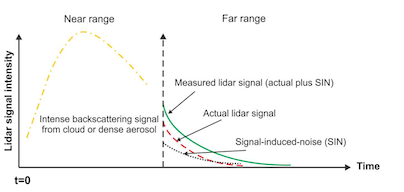
Well known problem with the Lidars. The laser direct signal perturbes the lidar incoming signal at very low altitudes. It saturates the photomultipliers thus making operation less than optimal. Blind the photomultiplier for the first few ns after the laser pulse resolves this issue.
Gating the photomultipliers
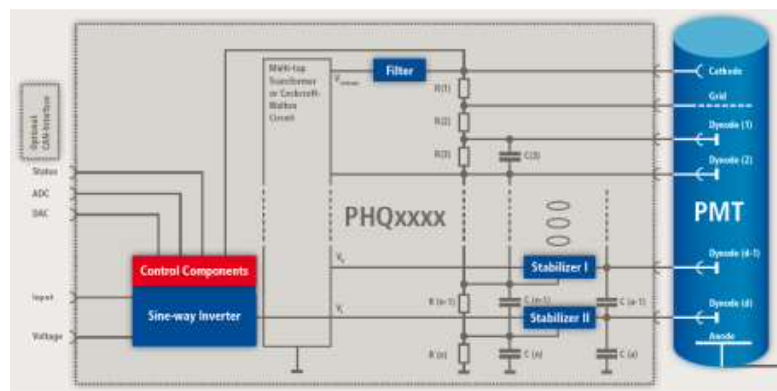
In order to increase the detected range and reduce the effect of signal-induced noise in LIDAR measurements of the high atmospheric layers, we have developed a normally off-gated photomultiplier tube module for use in both photon-counting and analog mode. The module allows the detection of the weak backscattering signal, while at the same time rejecting the intense backscattering signal from the near range with an adjustable rejection range. The gating of our module is based on the application of positive voltage pulses on the first dynodes of a photomultiplier base. The level of blinding is software adjustable.
Concept
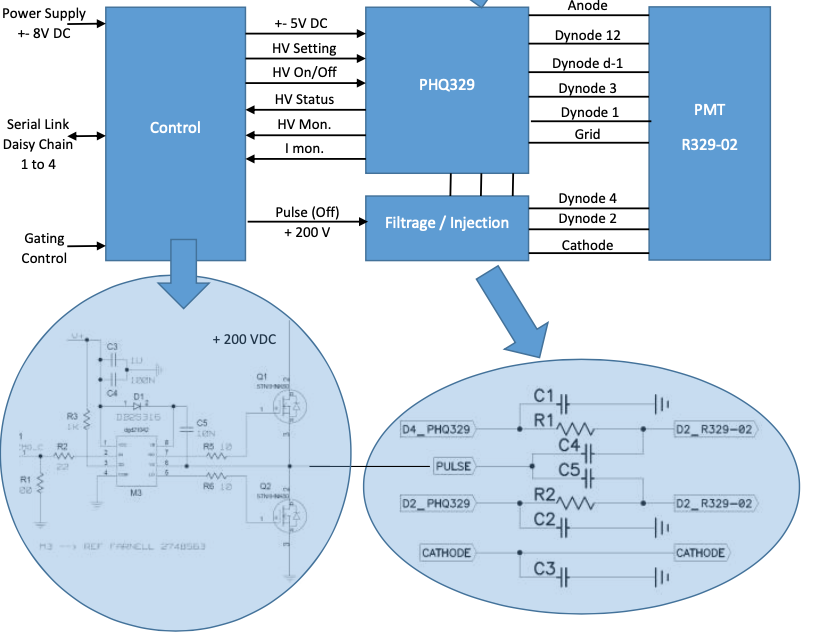
A fast +200V pulse is applied on the first dynodes of the photomultiplier, reducing considerably the gain and electron multiplication. An adjustable timewindow of few ns drive this operation timed after the laser pulsing protocole.After that the photomultiplier regain its optimal performance. A dedicate PLC code takes care of the timing and gating parameters settings.
Electronic Implementation
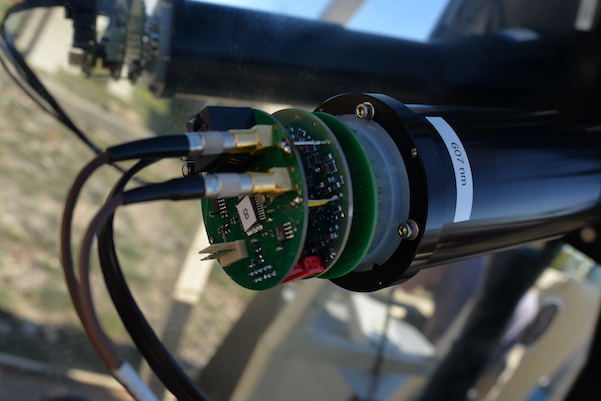
We use ISEG photomultiplier bases modified to accomodate the gating system. A fast +200V pulse is applied to lower the primary dynodes for an adjustable timewindow of few ns. A dedicate PLC code takes care of the timing and gatin parameters settins. Designed and built in a compact format the whole 2-wafer design is potted in epoxy to sustain enviroùmental conditions.
Testbench results
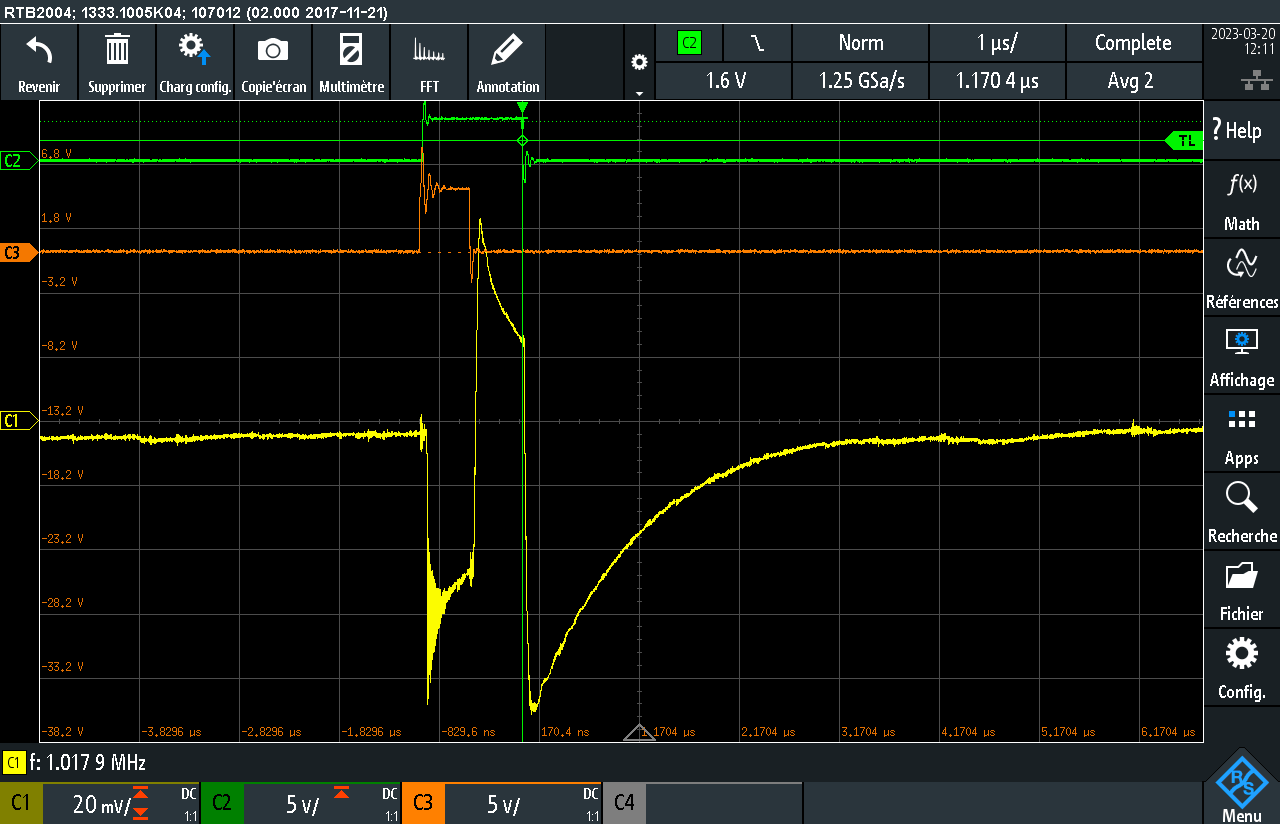
The pulsing system in action. Using a light source, we verify different configurations and options on the lab.
Green the light pulse. In orange the gating pulse. In yellow the photomultiplier signal after gating. For demonstration purposes only.
Photodetectors
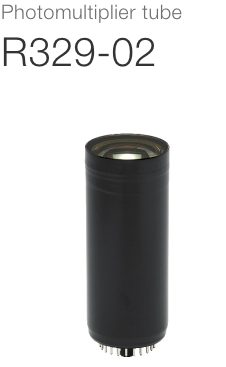
We use two type of HAMAMATSU photomultipliers. For all linbes accept the 607nm one, we opted for the 2 inche R392-P photomultiplier, a 12 dynode, high gain unit.
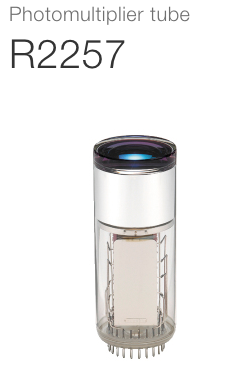
For the 607nm due to the very low incoming signal, we have opted for the 2 inch R2257 due to its more appropriate response at this specific wavelengh.